Faceless laboratory still life with empty collection tubes, sealed gauze, safety glasses and a blank notebook with deep-teal accents; no patient data or specimens

Bring These Seven Questions to Your Lab Review

The Precision Journal · Lab draws & testing

Bring These Seven Questions to Your Lab Review

A lab report is most useful when it starts a focused conversation. Use this short guide to understand why a test was ordered, what can affect it and what happens next.
Faceless laboratory still life with empty collection tubes, sealed gauze, safety glasses and a blank notebook with deep-teal accents; no patient data or specimens
Original editorial still life. The tubes are empty and the notebook is blank; no patient information, specimens or real results are shown.

Begin with the reason, not the flag

A portal may highlight a number before you have spoken with your provider. Resist the urge to treat one high or low flag as a diagnosis. The National Library of Medicine explains that laboratory results are interpreted with your history, symptoms, examination and other information. A result outside a reference range may or may not signal a health problem, and a result inside the range does not automatically rule one out. [1]

Your review becomes clearer when you know what question the test was meant to help answer. Bring the report if you have it, plus a short list of medicines, vitamins and supplements. Then work through the questions below.

Your seven-question review

  1. What was this test intended to evaluate?
    Ask whether the goal was screening, establishing a baseline, monitoring a known issue or checking how a plan is working. That purpose changes how an individual number should be discussed.
  2. Which findings matter most for me—and why?
    Instead of walking through every value with equal weight, ask which results deserve attention in the context of your goals, history and symptoms.
  3. Should we look at a trend rather than one result?
    A prior value can add context, but use care when comparing reports from different laboratories. Methods, units and reference ranges can differ. Ask whether the comparison is truly like-for-like. [1]
  4. Could preparation have affected anything?
    Mention whether you fasted as instructed, the time of the draw, recent strenuous exercise and any illness. Also disclose prescription and over-the-counter medicines, vitamins and supplements. Do not stop a medicine unless your provider tells you to. [2]
  5. What does this reference range mean for this specific test?
    Use the range printed by the laboratory that processed your sample—not a range copied from another report or found online. Ask how age, sex, method or other relevant factors are considered.
  6. Do we need to repeat, confirm or add a test?
    If follow-up is recommended, ask what it is meant to clarify, whether preparation will be different and when it should happen.
  7. What is the next step, and when should I check back?
    Leave with a concrete plan: what you will do, what the clinic will do, when you should expect an update and which symptoms or changes should prompt earlier contact.

A five-minute preparation note

Before your review, write down four things: the date and location of the draw; whether you followed the preparation instructions; your current medicines and supplements; and the two questions you most want answered. If you did not follow an instruction exactly, say so. That information may help the provider decide whether a result needs confirmation. [2]

Avoid changing medication, starting a supplement or repeating a test on your own based only on a portal flag. A useful review connects the number to its purpose and to your individual care.

How lab draws fit into care at LaserTouch MD

LaserTouch MD’s current lab service page describes the Bentonville office as a collection and care-coordination location. When testing is medically appropriate, specimen collection may be provided or coordinated there; samples may be processed by an outside laboratory. Available tests, ordering requirements, turnaround times and insurance or self-pay arrangements can vary.

That makes one question especially practical before the draw: “What preparation, order and follow-up process applies to this test?” The answer should come from the instructions for your specific order, not from a generic fasting rule.

Bring your questions to the appointment

Patients in Bentonville, Rogers and nearby Northwest Arkansas communities can learn more about in-house lab draws and wellness testing at LaserTouch MD. Testing is not a substitute for emergency care or a complete evaluation by your primary-care clinician.

Request a lab or wellness appointment

Need help choosing the right visit? Call 479-268-4573.
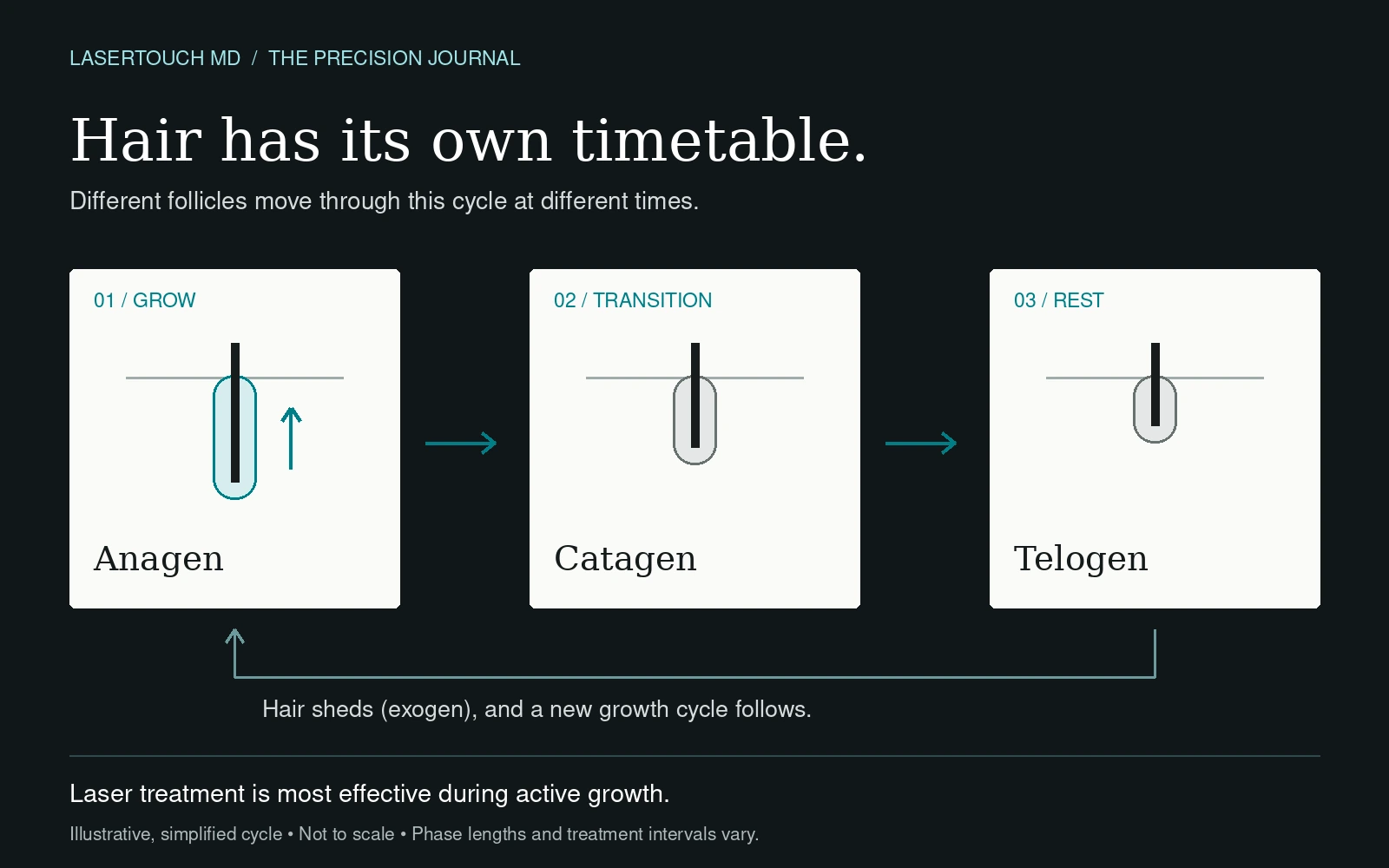
Illustrative hair-growth cycle: anagen growth, catagen transition and telogen rest, with shedding and a return to growth; follicles cycle at different times

Why Are Laser Hair Removal Visits Spaced Apart?

The Precision Journal · Laser hair removal

Why Are Laser Hair Removal Visits Spaced Apart?

Your next appointment is part of a biological timetable. Understanding that timetable makes a series easier to plan—and helps explain why squeezing visits together is not a shortcut.

Illustrative hair-growth cycle: anagen growth, catagen transition and telogen rest, with shedding and a return to growth; follicles cycle at different times
Original, simplified illustration. Follicles do not all move through these phases together. Phase lengths vary by body area and person; this is not an appointment schedule.

The hair you see is only part of the story

Laser hair removal uses light absorbed by pigment in hair to generate heat within the follicle. The American Society for Laser Medicine and Surgery describes this process as selective photothermolysis. A session treats an area, but the hairs within it are not all equally ready to respond.

Cleveland Clinic explains that the growth stage matters and follicles occupy different stages at different times. Repeated visits create opportunities to treat more hairs during active growth. Seeing some hair between appointments does not, by itself, tell you whether the previous treatment worked. Your provider needs to evaluate the pattern over time. [1, 2]

Three phases to know

  • Anagen: growth. The follicle is producing hair. This is the phase most relevant to effective laser hair reduction.
  • Catagen: transition. Active growth ends and the lower follicle regresses.
  • Telogen: rest. The follicle rests before another growth cycle. The old hair eventually sheds, a process called exogen.

The important idea is that neighboring follicles can be on different schedules. A diagram shows the sequence, not a countdown shared by every hair. [2, 3]

So how many weeks should you wait?

The American Academy of Dermatology says many patients can have sessions every four to six weeks. Cleveland Clinic describes sessions commonly spaced six to eight weeks apart. These general ranges illustrate why an internet calendar cannot replace your own treatment plan. [2, 4]

LaserTouch MD’s current service guidance bases spacing on the area, hair characteristics, skin and response. Ask for the recommended interval for each area you are treating. If you are doing both facial and body areas, ask whether their schedules should differ rather than automatically booking them together. Your provider should explain what will be reassessed before the next visit.

Moving a visit earlier does not make resting follicles enter active growth on demand. Let the treatment team decide whether a proposed date makes sense.

Make the gap between visits useful

Keep a short appointment note on your phone. This is a practical way to bring clearer observations to your next review:

  1. Name the area and date. Keep separate notes if you are treating more than one area.
  2. Describe the change. Are you noticing less frequent shaving, patchier growth or no obvious difference yet? Use ordinary observations instead of trying to calculate a percentage.
  3. Record the skin response. Note redness, discomfort and how long they lasted. Tell the clinic about unexpected or persistent symptoms.
  4. Flag schedule changes. Mention sunny travel, a new medication or another planned procedure before confirming the next session.

Follow your provider’s directions for shaving and sun protection. Avoid waxing or plucking as directed; these remove hair the treatment needs to target. See our preparation and aftercare guide for that separate part of the plan.

A changed appointment calls for a conversation

If work, travel or illness interrupts the series, contact the clinic with your last treatment date and the affected area. Ask how to resume and when to review progress. Do not add extra sessions close together to “catch up.”

Results vary, and maintenance may be needed. Temporary redness, swelling and discomfort can occur; burns, lasting pigment changes and scarring are possible. Blistering or a worsening reaction needs prompt advice from your treating provider rather than waiting until your next routine visit. [4]

Build a schedule you understand

For patients in Bentonville, Rogers and nearby Northwest Arkansas communities, a useful first question is: “What timing makes sense for my hair, skin and treatment area—and why?” Explore laser hair removal at LaserTouch MD, then bring that question to your consultation.

Book a laser consultation

Need help choosing a visit? Call 479-268-4573.

Sources checked October 20, 2026

  1. ASLMS: Laser hair removal
    https://www.aslms.org/topic/laser-hair-removal/
  2. Cleveland Clinic: Laser hair removal
    https://my.clevelandclinic.org/health/treatments/21757-laser-hair-removal
  3. Cleveland Clinic: Terminal hair and its growth cycle
    https://my.clevelandclinic.org/health/body/23140-terminal-hair
  4. AAD: Laser hair removal FAQs
    https://www.aad.org/public/cosmetic/hair-removal/laser-hair-removal-faqs

General education, not individual medical advice. Candidacy, device selection, treatment intervals and aftercare require individual assessment. No specific outcome is guaranteed.

Original editorial still life of a folded appointment card, invitation envelope, cotton cloth and black sun hat with a deep-teal ribbon

Planning a Perfect Derma Peel Around Your Social Calendar

← The Precision Journal

The Perfect Derma Peel · Give recovery room

Planning a Perfect Derma Peel Around Your Social Calendar

A wedding invitation, a work presentation, a weekend away: each changes the timing conversation.

Original editorial still life of a folded appointment card, invitation envelope, cotton cloth and black sun hat with a deep-teal ribbon
Original editorial illustration of appointment and event planning; no treatment products or patient results are pictured.

The invitation is on the counter. Your outfit is sorted. Now you are wondering whether a chemical peel belongs on the calendar before the big day. Start with the days after the appointment: can you protect your skin, follow aftercare and feel comfortable with visible peeling?

LaserTouch MD offers the standard Perfect Derma Peel in Bentonville. This guide helps you bring a useful timing question to your consultation. It is a planning aid, not a promise that your skin will look a particular way on a particular date.

Put the event on the calendar first

Tell your provider the exact date and what the occasion involves. A quiet indoor dinner has different practical demands from outdoor photographs, a hot dance floor or a week at the beach. Include rehearsals, travel days and work commitments—not just the main celebration.

The manufacturer advises scheduling a peel at least two weeks before an important event, with more time for a wedding. Treat that as a starting point for discussion. Your skin history, the selected treatment and your provider’s assessment may call for a longer interval or waiting until afterward.

What the first week may look like

The manufacturer’s FAQ describes visible peeling often starting around 72 hours after application, with the heaviest shedding commonly around days three through five. Some flaking may remain on days six and seven. The amount and timing vary.

A short application appointment therefore does not mean a short recovery window. Finishing visible peeling is also different from knowing how comfortable your skin will feel in makeup or photographs. Ask your provider how those milestones apply to you.

Three plans, three timing questions

A presentation or close-up photo session

Ask: “Which days should I keep flexible if I do not want visible shedding on camera?” Avoid booking by the appointment’s length alone. If a key presentation cannot move, make that constraint clear before choosing the treatment date. Your first peel leaves less personal experience to plan from than a treatment you have already had.

A wedding, reunion or big celebration

Ask: “How much extra room would you recommend beyond the usual peeling period?” Build the conversation around the earliest important date, such as engagement photos or a rehearsal dinner. Avoid adding a last-minute new product or extra exfoliation to hurry the process. A calm schedule can be more useful than squeezing in another treatment.

A sunny trip or active weekend

Ask: “Would it be better to wait until after this trip?” Manufacturer guidance cautions against planning a peel just before a sunny getaway and recommends avoiding heavy exercise, saunas and hot tubs during peeling. Mention hiking, pool time and outdoor work, too. Cooler Northwest Arkansas weather does not remove the need for sun protection.

Make aftercare part of the booking

Before you leave, confirm the written instructions for cleansing, moisturizing, sun protection and when to resume makeup and your usual skincare. Keep the clinic’s contact information beside those instructions. Do not pick, pull or scrub peeling skin; the American Academy of Dermatology explains that disrupting healing can raise infection and scarring risks.

Chemical peels can cause redness and irritation, and less common problems include persistent redness, pigment changes, infection and scarring. Contact your treating provider about concerning burning, itching or swelling rather than trying to cover or treat it yourself.

Bring a short “before I book” note

  • My dates: event, travel, outdoor commitments and days I can keep flexible.
  • My history: previous peels, recent procedures, current products and medications, allergies and cold sores.
  • My questions: suitability, preparation, recovery, makeup, follow-up and whom to contact with concerns.

Disclose pregnancy or breastfeeding and any current irritation, sunburn or skin infection. These can change whether treatment is appropriate. Have your provider set any product pauses or treatment spacing; another person’s instructions may not fit your skin.

Sources & further reading

Sources checked October 19, 2026. General education; follow your treating provider’s individualized instructions. Suitability, recovery and results vary.

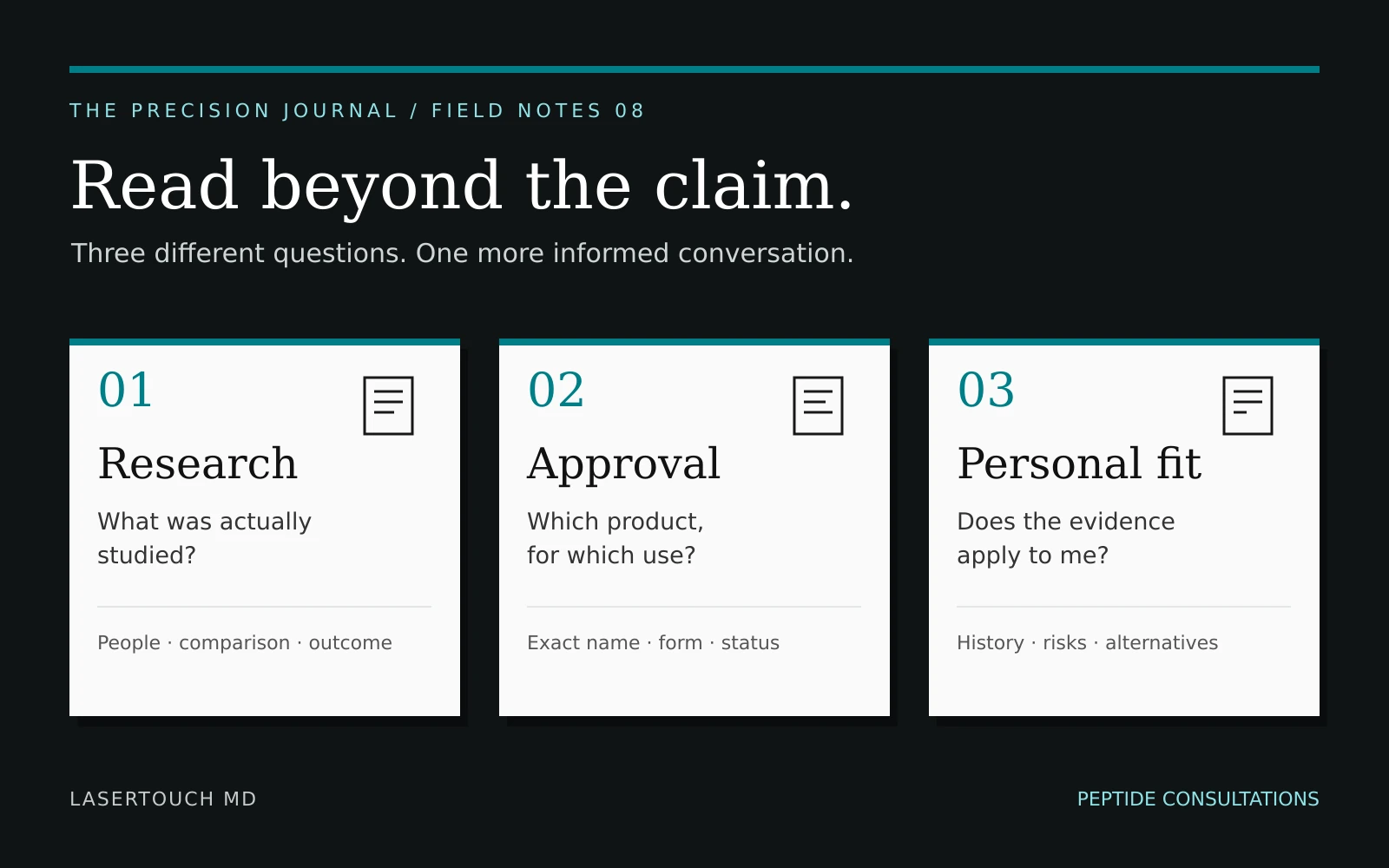
Three original evidence cards: research asks what was studied; approval asks which product and use; personal fit asks whether the evidence applies to you

How to Read a Peptide Claim Before Your Consultation

← The Precision Journal

Peptide consultations · Read beyond the headline

How to Read a Peptide Claim Before Your Consultation

Research, approval and personal fit answer different questions. Here is how to keep them separate.

Three original evidence cards: research asks what was studied; approval asks which product and use; personal fit asks whether the evidence applies to you
Original educational graphic. These are questions for evaluating a claim—not an endorsement of a product.

You see a confident peptide claim, save the post, and arrive at an appointment wondering whether it applies to you. That screenshot can be a useful starting point. It is not the same thing as a treatment recommendation.

Instead of asking only “Does this work?”, try organizing the claim into three evidence cards. This simple exercise turns a broad promise into questions a clinician can actually address. Keep the product name, source link and date with your notes; a cropped headline often leaves out the details that matter.

Card 01 / Research

What was actually studied?

Start with the study behind the statement, not the number of people sharing it. Was the research in people, animals or cells? What was measured, over how long, and compared with what? NIH’s science-literacy guidance encourages readers to ask whether a claim rests on human research and a wider body of evidence rather than one isolated study.

A result about a laboratory marker is not automatically evidence that people feel better, recover faster or live longer. Ask whether the reported outcome matches the benefit being advertised. Also note the formulation and how it was administered; an injection study should not be treated as proof that a mouth strip delivers the same result.

Card 02 / Approval

Which product, for which use?

Ask for the exact product name and its current regulatory status. FDA approval concerns a particular drug and intended uses—not every product containing a similarly named ingredient or every wellness goal associated with it.

Off-label means an approved drug is being used outside its approved labeling. The FDA explains that clinicians may sometimes do this when medically appropriate, but the agency has not established safety and effectiveness for that unapproved use. An unapproved compound does not become an approved drug simply because someone calls its use “off-label.”

Compounded is another distinct category. Compounded drugs are not FDA-approved and do not receive the same premarket review of safety, effectiveness and quality. A licensed pharmacy or a reference to “503A” or “503B” does not turn a compounded preparation into an FDA-approved product.

Card 03 / Personal fit

Does the evidence apply to me?

Even a well-supported finding is not a personal prescription. Ask whether the study population resembles your situation and what your medical history, allergies, medications and goals change about the decision. The conversation should include alternatives, reasons not to treat, monitoring and a point at which to reassess.

For a compounded option, ask why an approved medication cannot meet your medical need and which pharmacy would prepare it. FDA warns that poor compounding can introduce contamination or incorrect ingredient amounts, with potentially serious harm. “Personalized” should lead to a clear explanation, not a shortcut around questions.

Practice with one vague sentence

Imagine an advertisement says, “A peptide supports recovery.” This is a hypothetical example, not a claim about an available treatment. Before deciding what it means, fill in these blanks:

  • Recovery from what? Name the condition or activity and the outcome you care about.
  • Based on which evidence? Save the original study, not just a testimonial or a seller’s summary.
  • Which exact preparation? Record the ingredient, formulation and proposed use.
  • What remains uncertain? Note missing human data, unanswered safety questions or differences from your situation.

If you cannot fill in a blank, bring it to the appointment as a question. You do not need to settle the science on your own before asking for help.

What should I bring with my screenshot?

A link to the full claim, any cited study, the exact product name, your medication and supplement list, and a short description of your goal. Do not start a product or change prescribed treatment based on a post.

Bentonville + Rogers · Northwest Arkansas

Bring the claim. Ask for the context.

Explore LaserTouch MD’s peptide consultation information or book an in-clinic discovery session. Medical treatment requires qualified provider evaluation; a discovery visit does not guarantee a prescription or confirm that a particular compound is available. For appointment help, call 479-268-4573.

Explore the in-clinic discovery session ↗

Sources & further reading

  • NIH: evaluating trustworthiness in science
    https://www.nih.gov/about-nih/science-health-public-trust/tools/how-evaluate-trustworthiness-science
  • FDA: understanding off-label use
    https://www.fda.gov/patients/learn-about-expanded-access-and-other-treatment-options/understanding-unapproved-use-approved-drugs-label
  • FDA: compounding questions and answers
    https://www.fda.gov/drugs/human-drug-compounding/compounding-and-fda-questions-and-answers
  • FDA: risks of compounded drugs
    https://www.fda.gov/drugs/human-drug-compounding/understanding-risks-compounded-drugs

Sources checked October 18, 2026. General education, not individual medical advice. Evidence, regulatory status and availability must be checked for the exact product and intended use at the time of care.

Ciara RN, Advanced Injector at LaserTouch MD. Tuesday October 20, 10 AM–1:30 PM. Appointments required. Tox $10 per unit, $100 off filler, book a Tox Party and get 30 free units.

Tox & Filler Special with Ciara RN — Tuesday, October 20

Tox and Filler Special with Ciara RN. Appointments required Tuesday October 20, 10 AM–1:30 PM

Book your Tuesday appointment with Ciara RN at LaserTouch MD in Bentonville! Our Tox & Filler Special is available for appointments on Tuesday, October 20, 2026, between 10:00 AM and 1:30 PM CDT. Appointments are required, so reserve your treatment time in advance.

Meet Ciara RN

Ciara is our Advanced Trained Injector. Whether this is your first appointment or part of your regular routine, your visit is an opportunity to discuss your goals and ask the questions that matter to you.

You can talk about your goals, ask what an appointment involves, and discuss whether a consultation is the right next step. A personal conversation is a helpful place to begin; treatment recommendations depend on an individual provider assessment.

Which areas would you like to treat?

Talk with Ciara about restoring volume and enhancing definition in the cheeks, chin, jawline, temples, and lips, or softening lines around the mouth, forehead, and eyes. She will discuss which treatment options fit your goals during your appointment.

Tuesday appointment specials

  • Book a TOX appointment and get TOX for $10 per unit.
  • Book filler and receive $100 off.
  • Book a TOX Party and get 30 free units of TOX!

Interested in the TOX Party offer? Call our team to arrange your party and ask about available dates and the 30-free-unit offer details.

Bring your questions

Not sure what to ask? You might want to discuss your goals, the options Ciara would consider for you, what preparation or aftercare may involve, and how your appointment and pricing would be planned. Ciara can also explain which questions require a personal consultation.

To take advantage of the Tuesday tox and filler specials, book an appointment for October 20 between 10:00 AM and 1:30 PM. Our team will help you reserve a time with Ciara. Selecting Going or Interested on Facebook does not reserve a treatment appointment.

Book your Tuesday appointment in Bentonville

Tuesday, October 20, 2026 · 10:00 AM–1:30 PM CDT

LaserTouch MD · 800 SE Walton Blvd, Suite 12, Bentonville, AR 72712

Explore Ciara’s Jane booking page or call 479-268-4573 to book. Jane may ask you to contact the clinic for Ciara’s appointments; if so, give us a call and we will help you reserve your visit.

Call today to reserve your Tuesday appointment with Ciara. We look forward to welcoming you for your scheduled visit!

Provider assessment required. Ask the clinic for offer details.

View Ciara in Jane   Call to book

Illustrative empty treatment bed with white linens, a black bolster and a small raspberry accent; no device or patient shown

Inside a PHYSIQ Appointment: Equipment, Goals and Comfort

← The Precision Journal

PHYSIQ · A closer look at the appointment

Inside a PHYSIQ Appointment: Equipment, Goals and Comfort

Know what touches your skin, what the settings mean, and when to speak up.

Illustrative empty treatment bed with white linens, a black bolster and a small raspberry accent; no device or patient shown
Original editorial illustration—not a photograph of LaserTouch MD’s treatment room or PHYSIQ equipment.

A body-contouring appointment should feel understandable before a setting is switched on. What are those applicators for? Will you feel warmth, muscle contractions, or both? How do you ask for a pause?

LaserTouch MD’s current PHYSIQ service page describes a combination of deep heat and electrical muscle stimulation (EMS). This guide follows that description. PHYSIQ and PHYSIQ 360 should not be treated as interchangeable specifications; ask the team to identify the model and explain the proposed treatment for you.

01 / Meet the equipment before you begin

Cartessa’s original PHYSIQ materials describe a console connected to four applicators, with settings adjustable for each applicator. The applicators are the parts positioned at the treatment area. They can deliver deep heat, EMS, or a sequence of the two, depending on the treatment plan. Seeing four applicators does not mean every person needs all four.

“Hands-free” describes how the applicators work once positioned; it is not a reason to leave questions unanswered. Before starting, ask the provider to show you which area each applicator is addressing and how the planned settings relate to your goal. You should also know how to get the provider’s attention throughout the session.

Try this question: “Can you explain what each applicator will do, and how I should tell you if I need an adjustment or a pause?”

02 / Separate the goal from the sensation

Heat and EMS are different parts of the treatment. The thermal component involves warmth; EMS stimulates muscle contractions. Ask what sensations are expected with the modes selected for you, including whether they change during the session. Your description matters more than trying to match someone else’s experience.

Do not use intensity as a scorecard or assume a stronger sensation means a better outcome. Describe what you notice in plain language: where it is, whether it feels hot or pulling, and whether it has changed. Report pain or concerning heat promptly rather than waiting for the timer to finish.

03 / Make comfort a two-way conversation

Before applicators are positioned, discuss how you will lie or sit and whether that position is comfortable. Ask what happens if you need to move. Confirm the expected treatment time separately from the total visit time, which may also include assessment, setup and instructions. Do not build your schedule around a generic online session length.

What health details should I mention?

Tell the provider about pregnancy, implanted electronic devices or metal, recent surgery, skin problems and reduced sensation in the area, as well as medications and relevant medical history. These details can affect whether treatment is appropriate. The provider should screen you against the instructions for the exact device.

Does “non-invasive” mean risk-free?

No. The FDA notes that non-invasive body-contouring procedures can cause pain, redness, swelling or bruising; heat-based treatment can also cause burns. Ask which risks apply to your proposed treatment and what symptoms should prompt a call. Body contouring does not treat obesity or replace weight-loss care; changes vary and may be temporary.

04 / Leave with a review plan, not a prediction

Before leaving, request your specific aftercare instructions, a contact route for concerns and a realistic review date. Ask how the team will assess change and decide whether another visit makes sense. A series should have a reason beyond filling a calendar.

Keep a short note of the treated area, your experience and any questions that arise afterward. At review, bring that note back. A useful conversation can lead to continuing, adjusting, waiting or deciding that another approach better fits your priorities.

Bentonville + Rogers · Northwest Arkansas

Start with a clear conversation.

Explore PHYSIQ at LaserTouch MD and bring your equipment and comfort questions to a consultation. For appointment help, call 479-268-4573.

Explore PHYSIQ appointments ↗

Sources & further reading

Sources checked October 17, 2026. This is an appointment discussion guide, not a description of every patient’s protocol or individualized medical advice. Suitability, settings, timing and results vary.

White standing paper calendar with three empty appointment blocks, a raspberry tab and a black pencil

Aesthetics 365™: Build a Treatment Calendar Around Your Priorities

← The Precision Journal

Aesthetics 365™ · Make room for what matters

Build a Treatment Calendar Around Your Actual Priorities

Three appointment blocks. A little breathing room. A plan that fits your life.

White standing paper calendar with three empty appointment blocks, a raspberry tab and a black pencil
Original editorial illustration: leave space for assessment, treatment when appropriate, and review.

A calendar can look organized and still be wrong for you. Perhaps it puts a new procedure beside an important work presentation, overlooks a vacation, or leaves no room to talk about how your skin responded. The useful question is: what does each appointment need to accomplish?

Aesthetics 365™ at LaserTouch MD connects assessment, care and ongoing review. Its six phases are an illustrative framework; they can overlap, and treatment timing is individualized. Here is a practical way to turn that bigger picture into a calendar you can discuss at your Bentonville consultation.

Start with the dates you already have

Write down weddings, travel, outdoor plans and weeks when you cannot easily change your routine. Include ordinary constraints, too: school pickups, exercise commitments, work shifts and the time you can realistically set aside for appointments.

Beside those dates, add one sentence about your main priority. “I want to discuss uneven-looking texture” gives the conversation a focus. Add what you want to preserve about your appearance, and a comfortable spending range. Keep other interests on a “later” list so they do not quietly become commitments.

Give three kinds of appointments a place

BLOCK 01 / UNDERSTAND

The consultation

This is where the calendar becomes personal. Bring your treatment history, current products, medications and supplements. Ask about suitability, realistic changes, alternatives and risks. The American Academy of Dermatology recommends discussing the provider’s experience, recovery and total costs before cosmetic care. Leave with a clear next step, which may include time to think.

BLOCK 02 / MAKE SPACE

The treatment, if appropriate

Before assigning a date, ask how much appointment time, preparation and recovery the specific procedure may require. Record the instructions alongside the booking. If you are considering more than one procedure, have your clinician explain the sequence and spacing. An open afternoon on your calendar does not establish that two treatments belong together.

BLOCK 03 / TAKE STOCK

The review

Ask when your response can reasonably be assessed and how follow-up works. Keep a short note of your experience and questions between visits. A review can lead to continuing, adjusting, waiting or stopping. It deserves its own space before you commit to another round of treatment.

Make the blank spaces useful

Leave room for the ordinary life surrounding your appointments. Discuss how travel, sun exposure, exercise or a special event may affect preparation and aftercare for the option you are considering. Ask when you can resume your usual activities; avoid borrowing a friend’s recovery timeline.

One helpful planning note has four fields: purpose, date, instructions and review question. For example: “Consultation about texture; date to confirm; bring my product list; ask whether my upcoming trip changes the options.” That is a useful first entry even before a treatment is selected.

Two calendar decisions worth pausing over

“Can I fit a new treatment in before an event?”

Tell the clinician the exact event date and how comfortable you are with visible recovery. Ask whether waiting until afterward would make more sense. No calendar can guarantee that your skin will look a particular way on a particular day.

“Should I book the whole year now?”

Start with the next agreed step and clarify any recommended series, cancellation terms and review points. A year-long perspective can be useful without filling every month. Your priorities, schedule and response may change.

Bentonville + Rogers · Northwest Arkansas

Bring your calendar. Bring your priorities.

Explore the current Aesthetics 365™ plan, then talk with LaserTouch MD about a next step that fits. For help choosing an appointment, call 479-268-4573.

Explore appointments ↗

Sources & further reading

Sources checked October 16, 2026. This calendar is a discussion tool, not an individualized treatment schedule. Suitability, timing, risks and results vary.

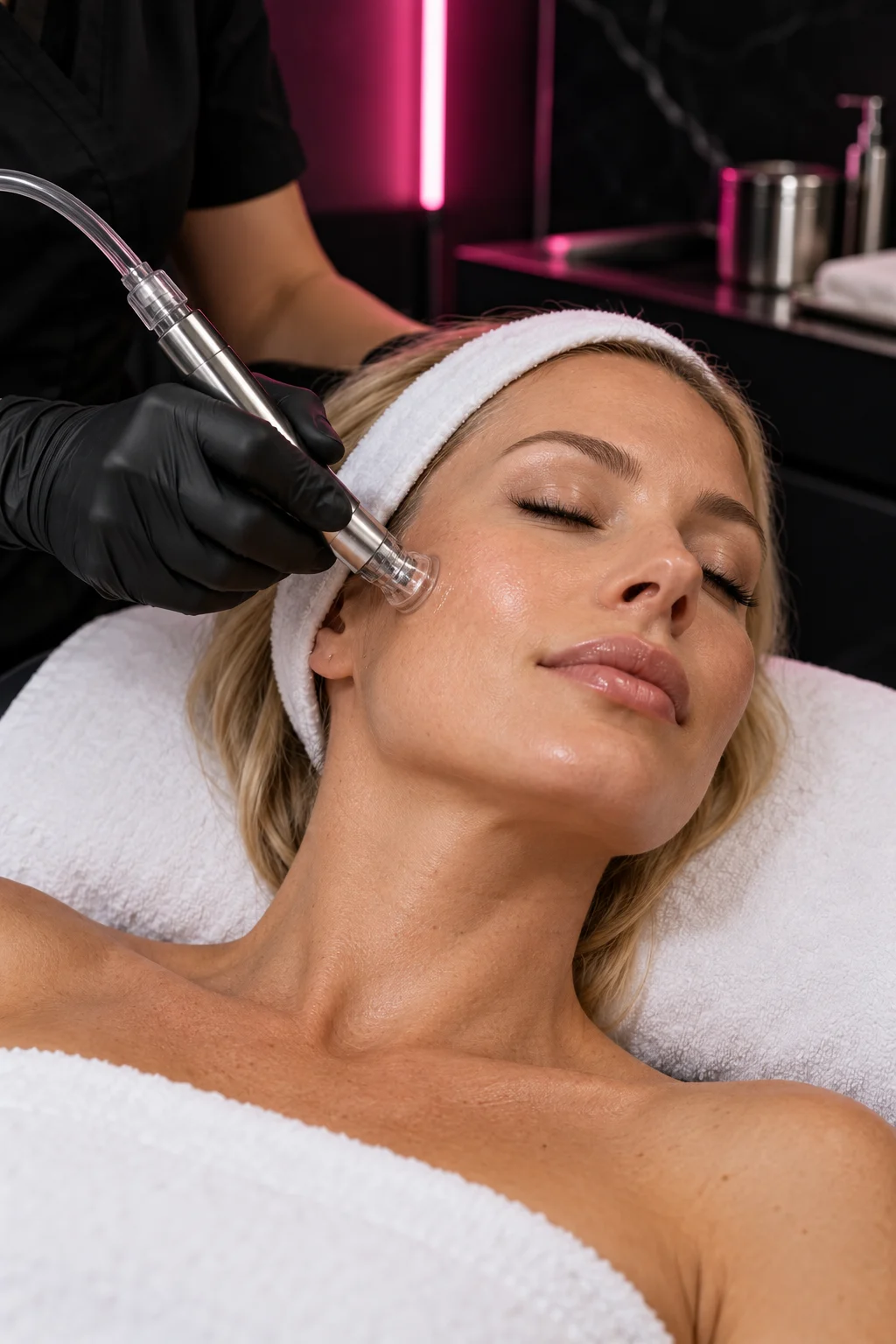
Clear HydroSpa facial handpiece used near the cheek while the client rests on a white towel

What Happens During a Diamond Hydrospa Facial?

LaserTouch MD · Precision Journal · Bentonville & Rogers

What Happens During a Diamond Hydrospa Facial?

A useful facial menu should tell you more than the price. Here is the current LaserTouch MD HydroSpa flow—from the first skin conversation through diamond-tip exfoliation, hydration and the final at-home guidance.

Book a HydroSpa facial ↗

Clear HydroSpa facial handpiece used near the cheek while the client rests on a white towel
Illustrative HydroSpa treatment image from the current service page. The provider adapts facial steps to the individual skin assessment.

The “diamond” in Diamond Hydrospa refers to the surface-exfoliation step—not a one-size-fits-all formula.

The Diamond Hydrospa Facial is $125 at LaserTouch MD. It combines professional cleansing, diamond-tip surface exfoliation, pore-focused care when appropriate, hydrating skincare and finishing care.

The order may feel simple, but the useful part is the adjustment: your skin condition, comfort and current routine help determine how the appointment is approached. Results vary, and the goal of the visit should be discussed before treatment begins.

The appointment, step by step

From the first look to the final layer.

1

Start with a quick skin conversation

Share what you want from the visit, what products you use, any recent procedures and anything that is making your skin feel unusually reactive. This is the moment to mention sensitivities and ask which steps fit today.

2

Cleanse the surface

Professional cleansing removes makeup, sunscreen and the day’s buildup so the provider can work on clean skin and see the surface more clearly.

3

Use the diamond-tip handpiece

The clear handpiece supports controlled surface exfoliation. It is moved across treatment areas rather than left in one place. The purpose is cosmetic surface refinement; it is not an injectable or a laser procedure.

4

Focus on pores when appropriate

The current facial includes pore-focused care when it suits the skin assessment. That wording matters: more pressure or more passes are not automatically better, and not every area needs the same attention.

5

Replenish with hydrating skincare

After exfoliation, the appointment shifts to hydration and comfort. Products and technique are selected as part of the facial rather than treated as a fixed promise of a particular outcome.

6

Finish—and leave with a plan

Finishing care completes the service. Before you go, ask when to resume active skincare, how to protect your skin and when another facial would make sense for your goals.

Choose the version you mean

Classic Diamond Hydrospa or the Pink Collagen ritual?

LaserTouch MD currently lists two different services. Keeping the names straight makes booking—and expectations—much easier.

$125

Diamond Hydrospa Facial

  • Professional cleansing
  • Diamond-tip surface exfoliation
  • Pore-focused care when appropriate
  • Hydrating skincare and finishing care
$145

Diamond PDRN Pink Collagen Hydrospa Facial

  • Diamond Hydrospa Facial care
  • PDRN Pink Collagen Mask
  • Red-light therapy
  • Personalized finish and aftercare guidance

The $145 facial is the separate option that includes the PDRN Pink Collagen Mask and red-light step. Ask which service name is on your appointment so you know exactly what you booked.

A consistency option

Where the Skin & Scalp Club fits.

The current club is designed around the standard Diamond Hydrospa Facial and the 60-minute Scalp Retreat Head Spa.

$99 / month

Choose one Head Spa or one Diamond Hydrospa Facial each month, and switch between them from month to month.

$198 / month

Choose both monthly. The $145 PDRN Pink Collagen facial is a separate option; ask the team about the current member upgrade price and terms.

Review the current Skin & Scalp Club details ↗

Before you settle in

Four questions worth bringing.

  1. Which HydroSpa service name is on my appointment?
  2. Should I pause or change any skincare before or after this visit?
  3. How will today’s steps be adjusted for my skin?
  4. When should I contact the clinic about an unexpected reaction?

Clinic sources

LaserTouch MD: HydroSpa Facials in Bentonville · LaserTouch MD: Skin & Scalp Club

Bentonville first · Rogers nearby

Book the facial you actually want.

Tell the LaserTouch MD team whether you want the $125 Diamond Hydrospa Facial or the $145 Diamond PDRN Pink Collagen Hydrospa Facial, then bring your current skincare and timing questions to the visit.

Book online ↗

Explore HydroSpa · Call 479-268-4573

General service information, not individual medical advice. Suitability, treatment details, skin response and results vary. Contact the clinic promptly about unexpected symptoms.

Faceless flat lay of dumbbells and home exercise equipment representing the movement part of a medical weight-loss plan

What Belongs in a Medical Weight-Loss Plan Besides a Prescription?

LaserTouch MD · The Precision Journal · Medical Weight Management

What Belongs in a Medical Weight-Loss Plan Besides a Prescription?

Medication may be one useful tool. A plan you can actually follow also needs a health baseline, food and movement strategies, honest tracking, and a clear way to adjust.

Faceless flat lay of dumbbells and home exercise equipment representing the movement part of a medical weight-loss plan
A prescription can be one part of a plan; movement, nutrition and follow-up give the plan its structure. Photo by Alexandra Tran on Unsplash.

A medical weight-loss consultation should be bigger than a number on the scale or a medication name. The goal is to understand what may be affecting your weight, which options fit your health history, and what kind of support can make the plan realistic in ordinary life.

That approach matches the current LaserTouch MD GLP-1 weight-management page, which describes medical-history review, personalized treatment planning, nutrition and activity guidance, and ongoing monitoring. Treatment may include semaglutide or tirzepatide when appropriate for you after evaluation by a licensed medical provider.

Six pieces worth putting on the same page

01 · Baseline

Your full health picture

Bring your medical conditions, current medicines and supplements, allergies, previous weight-loss attempts, and relevant family history. Pregnancy plans, diabetes care, digestive symptoms and upcoming procedures are also important to discuss because they can change which options are appropriate.

02 · Priorities

A goal beyond “lose weight”

Choose practical outcomes you can notice and review: easier movement, steadier meal planning, better energy for daily activities, or improvement in a clinician-monitored health marker. A useful goal has a time frame, but it should not promise a particular result.

03 · Food

An eating pattern you can repeat

A plan should account for your schedule, preferences, culture, budget and health needs. The National Institute of Diabetes and Digestive and Kidney Diseases recommends a healthy reduced-calorie eating plan that can be maintained over time—not a crash diet built around a short burst of willpower.

04 · Movement

Activity matched to your ability

Walking, resistance work and other forms of movement can be discussed around your current fitness, limitations and medical history. The best starting point is specific enough to follow and flexible enough to continue; more is not automatically better.

05 · Context

Sleep, stress and real-life barriers

Work hours, caregiving, travel, sleep and stress can all shape eating and activity. The CDC includes enough sleep and stress management alongside nutrition and physical activity in a healthy weight-loss plan. Naming the friction is part of designing around it.

06 · Follow-up

A way to learn and adjust

Agree on what to track, when to check in, which symptoms deserve a call, and how the plan may change. Progress includes tolerability and health—not only weight. Ongoing monitoring matters whether the next step is lifestyle support, medication, or a different medical recommendation.

Bring these five questions to your consultation

  • What information do you need before deciding whether medication is appropriate for me?
  • Which nutrition and movement goals should I focus on first?
  • What should I track between visits—symptoms, habits, measurements or lab results?
  • Which side effects or changes should prompt me to contact the clinic?
  • How will we review progress, tolerability and the longer-term maintenance plan?

These questions keep the conversation centered on fit, safety and follow-through. They also make room for a perfectly valid outcome: deciding that a particular medication is not the right tool for you.

Start with the whole plan.

Request a consultation or call 479-268-4573. LaserTouch MD welcomes patients from Bentonville, Rogers and nearby Northwest Arkansas communities.

Sources: LaserTouch MD GLP-1 Weight Management; NIDDK weight-management guidance; CDC: Steps for Losing Weight; and current Wegovy prescribing information. Sources checked October 14, 2026. This article is general education, not individualized medical advice or a promise of results.

Faceless still life of aromatic botanicals representing Head Spa scent choices

Choose Your Head Spa Escape: Four Aromas, One Scalp Ritual

LaserTouch MD · The Precision Journal · Head Spa

Choose Your Head Spa Escape: Four Aromas, One Scalp Ritual

Fresh mint, warm woods, soft lavender or bright citrus? Your aroma sets the mood; the full 60-minute Scalp Retreat carries you through the same ten thoughtful steps.

Faceless still life of aromatic botanicals representing Head Spa scent choices
Four aromatic directions, one unhurried Scalp Retreat. Photo by volant on Unsplash. Aroma availability may vary, and a no-added-scent option is available.

Choosing a Head Spa aroma is less about finding a “correct” ingredient and more about deciding how you want the appointment to feel. LaserTouch MD’s Scalp Retreat Head Spa begins with that small sensory choice, then moves through a 60-minute, ten-step scalp, hair and relaxation ritual.

Here is a simple way to meet the four current blends before you arrive. The mood descriptions are sensory shorthand—not medical benefits or promises.

Which aroma sounds like your kind of pause?

Fresh + clear

Mint Escape

Peppermint and eucalyptus create a crisp, mint-forward atmosphere for guests who like their spa experience to feel bright and refreshing.

Think: cool garden leaves and a clean first breath.

Warm + grounded

Wild Refuge

Cedarwood and frankincense lean woodsy and resinous—a quieter choice when you want the room to feel cozy rather than floral.

Think: dry woods, soft resin and a slow exhale.

Soft + floral

Lavender Fields

Lavender and cedarwood balance familiar floral notes with a gentle woody base. It is a classic direction without feeling overly sweet.

Think: lavender sprigs resting on pale cedar.

Bright + sunny

Citrus Daydream

Sweet orange and lavender pair a lively citrus note with a softer floral finish for an easy, cheerful ritual.

Think: freshly opened citrus beside dried lavender.

The scent changes. The ritual stays complete.

Your aroma is the opening step, not a substitute for the treatment. The current Scalp Retreat sequence combines cleansing, scalp care, hair conditioning, comfort and a finished style.

Begin

Choose your aroma, then settle into steam and an antioxidant-oil scalp massage followed by a salt-scrub exfoliation.

Refresh

Waterfall halo rinses frame a deep-cleansing shampoo and a deep-conditioning hair mask with steam.

Finish

The ritual closes with another halo rinse, peptide scalp nutrients and a blow-dry finish.

The experience is designed as cosmetic scalp care, hair care and relaxation. It is not a treatment for hair loss or a medical scalp condition; those concerns deserve a separate personal evaluation.

Your 30-second note before booking

A few details help the Head Spa team discuss how the experience may fit your hair and comfort preferences:

  • Any fragrance or ingredient sensitivities
  • Extensions, protective styles or scalp tenderness
  • Recent color, chemical or other hair services
  • Your preferred aroma—or your request for no added scent

Make it a one-time escape or a monthly ritual

The Scalp Retreat Head Spa is currently $115. With the Skin & Scalp Club, members may choose one Head Spa or one Diamond Hydrospa Facial each month for $99, switch between them monthly, or enjoy one of each for $198.

Pick the mood. Keep the full ritual.

Find a Head Spa appointment or call 479-268-4573. LaserTouch MD welcomes guests from Bentonville, Rogers and nearby Northwest Arkansas communities.

Sources: LaserTouch MD Scalp Retreat Head Spa and the current Skin & Scalp Club materials. Sources checked October 13, 2026. Service details and aroma availability can change; confirm preferences and suitability when booking.