
Why Are Laser Hair Removal Visits Spaced Apart?
The Precision Journal · Laser hair removal
Why Are Laser Hair Removal Visits Spaced Apart?
Your next appointment is part of a biological timetable. Understanding that timetable makes a series easier to plan—and helps explain why squeezing visits together is not a shortcut.
The hair you see is only part of the story
Laser hair removal uses light absorbed by pigment in hair to generate heat within the follicle. The American Society for Laser Medicine and Surgery describes this process as selective photothermolysis. A session treats an area, but the hairs within it are not all equally ready to respond.
Cleveland Clinic explains that the growth stage matters and follicles occupy different stages at different times. Repeated visits create opportunities to treat more hairs during active growth. Seeing some hair between appointments does not, by itself, tell you whether the previous treatment worked. Your provider needs to evaluate the pattern over time. [1, 2]
Three phases to know
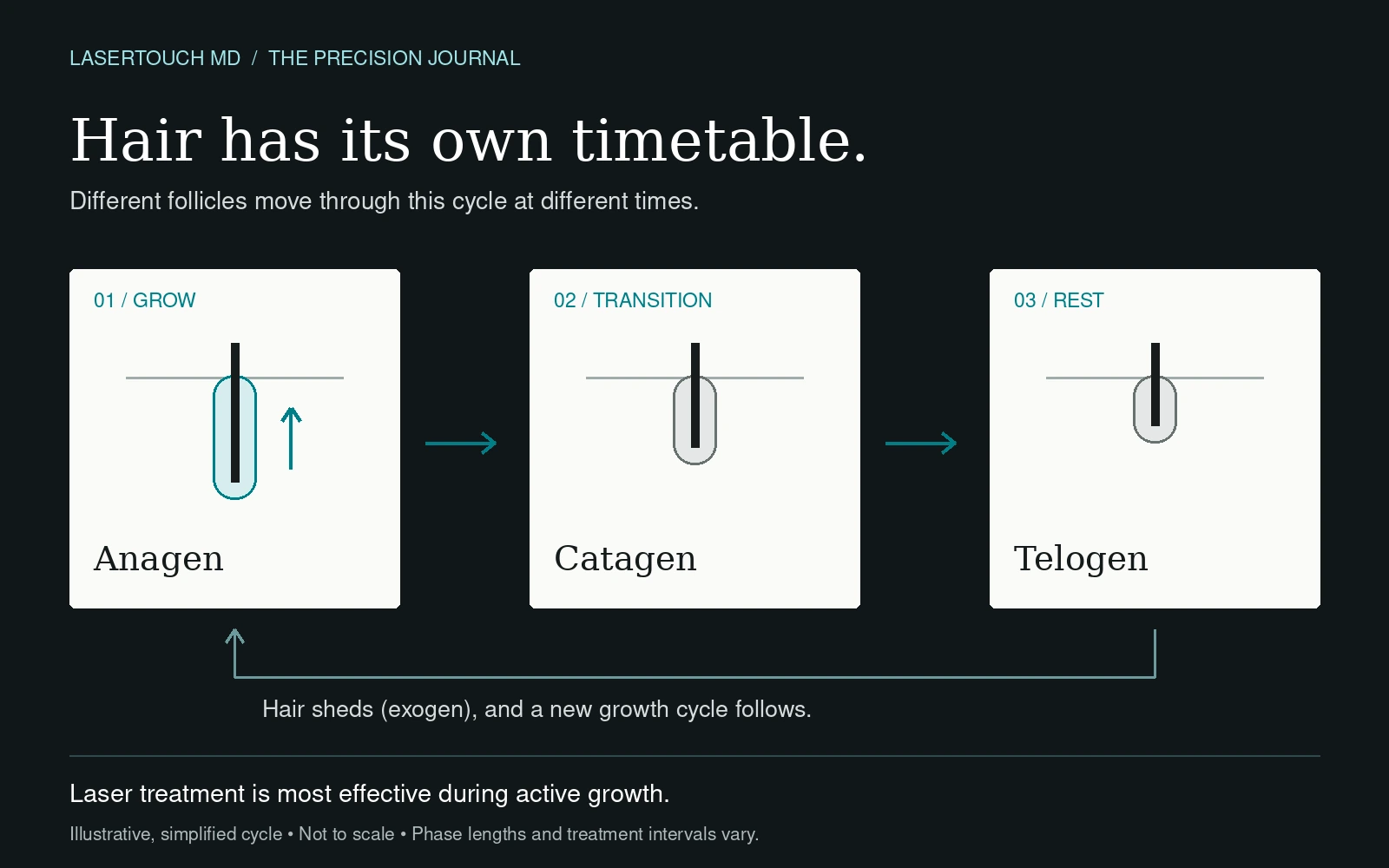
- Anagen: growth. The follicle is producing hair. This is the phase most relevant to effective laser hair reduction.
- Catagen: transition. Active growth ends and the lower follicle regresses.
- Telogen: rest. The follicle rests before another growth cycle. The old hair eventually sheds, a process called exogen.
The important idea is that neighboring follicles can be on different schedules. A diagram shows the sequence, not a countdown shared by every hair. [2, 3]
So how many weeks should you wait?
The American Academy of Dermatology says many patients can have sessions every four to six weeks. Cleveland Clinic describes sessions commonly spaced six to eight weeks apart. These general ranges illustrate why an internet calendar cannot replace your own treatment plan. [2, 4]
LaserTouch MD’s current service guidance bases spacing on the area, hair characteristics, skin and response. Ask for the recommended interval for each area you are treating. If you are doing both facial and body areas, ask whether their schedules should differ rather than automatically booking them together. Your provider should explain what will be reassessed before the next visit.
Moving a visit earlier does not make resting follicles enter active growth on demand. Let the treatment team decide whether a proposed date makes sense.
Make the gap between visits useful
Keep a short appointment note on your phone. This is a practical way to bring clearer observations to your next review:
- Name the area and date. Keep separate notes if you are treating more than one area.
- Describe the change. Are you noticing less frequent shaving, patchier growth or no obvious difference yet? Use ordinary observations instead of trying to calculate a percentage.
- Record the skin response. Note redness, discomfort and how long they lasted. Tell the clinic about unexpected or persistent symptoms.
- Flag schedule changes. Mention sunny travel, a new medication or another planned procedure before confirming the next session.
Follow your provider’s directions for shaving and sun protection. Avoid waxing or plucking as directed; these remove hair the treatment needs to target. See our preparation and aftercare guide for that separate part of the plan.
A changed appointment calls for a conversation
If work, travel or illness interrupts the series, contact the clinic with your last treatment date and the affected area. Ask how to resume and when to review progress. Do not add extra sessions close together to “catch up.”
Results vary, and maintenance may be needed. Temporary redness, swelling and discomfort can occur; burns, lasting pigment changes and scarring are possible. Blistering or a worsening reaction needs prompt advice from your treating provider rather than waiting until your next routine visit. [4]
Build a schedule you understand
For patients in Bentonville, Rogers and nearby Northwest Arkansas communities, a useful first question is: “What timing makes sense for my hair, skin and treatment area—and why?” Explore laser hair removal at LaserTouch MD, then bring that question to your consultation.
Need help choosing a visit? Call 479-268-4573.