
How to Read a Peptide Claim Before Your Consultation
Peptide consultations · Read beyond the headline
How to Read a Peptide Claim Before Your Consultation
Research, approval and personal fit answer different questions. Here is how to keep them separate.
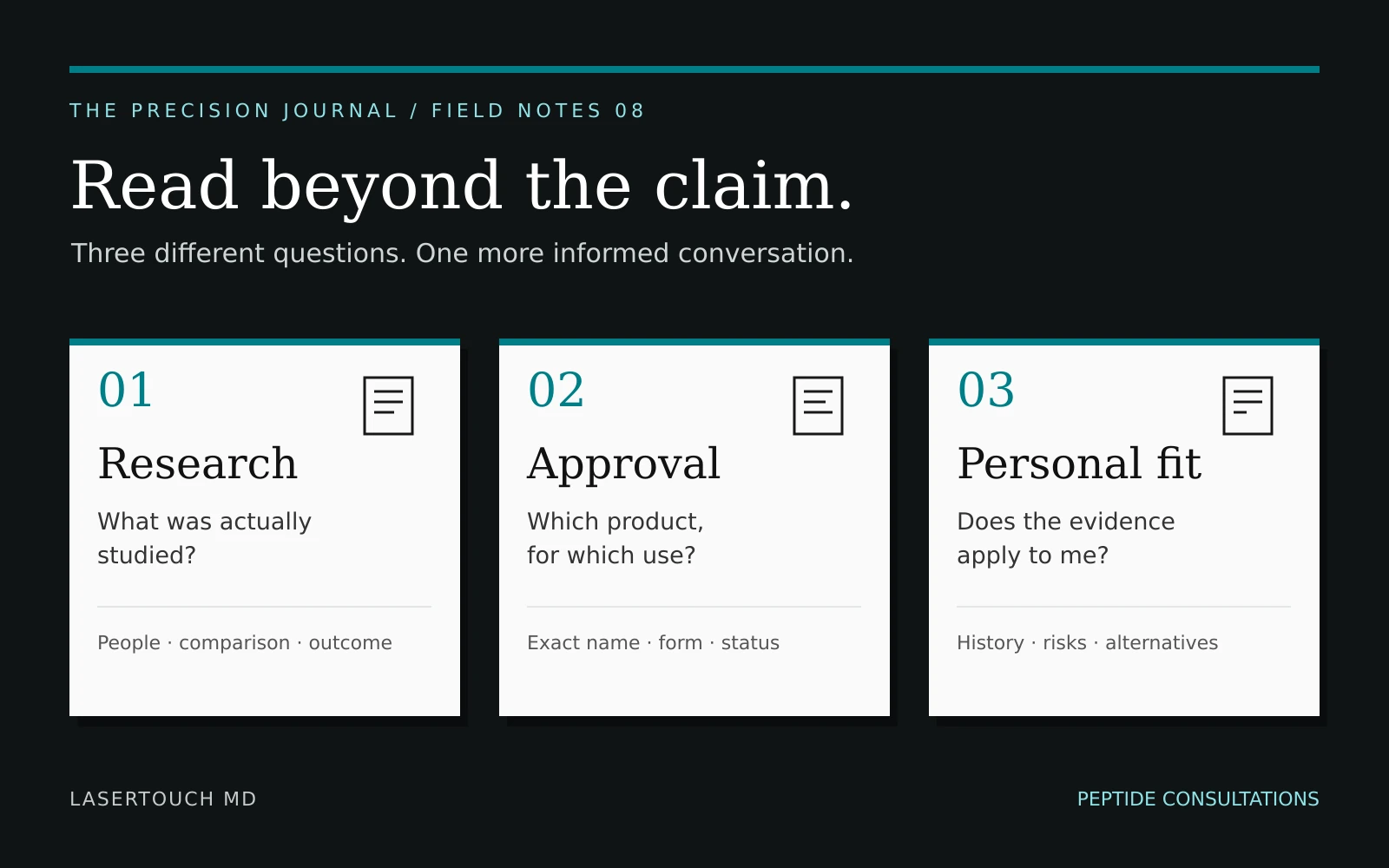
You see a confident peptide claim, save the post, and arrive at an appointment wondering whether it applies to you. That screenshot can be a useful starting point. It is not the same thing as a treatment recommendation.
Instead of asking only “Does this work?”, try organizing the claim into three evidence cards. This simple exercise turns a broad promise into questions a clinician can actually address. Keep the product name, source link and date with your notes; a cropped headline often leaves out the details that matter.
Card 01 / Research
What was actually studied?
Start with the study behind the statement, not the number of people sharing it. Was the research in people, animals or cells? What was measured, over how long, and compared with what? NIH’s science-literacy guidance encourages readers to ask whether a claim rests on human research and a wider body of evidence rather than one isolated study.
A result about a laboratory marker is not automatically evidence that people feel better, recover faster or live longer. Ask whether the reported outcome matches the benefit being advertised. Also note the formulation and how it was administered; an injection study should not be treated as proof that a mouth strip delivers the same result.
Card 02 / Approval
Which product, for which use?
Ask for the exact product name and its current regulatory status. FDA approval concerns a particular drug and intended uses—not every product containing a similarly named ingredient or every wellness goal associated with it.
Off-label means an approved drug is being used outside its approved labeling. The FDA explains that clinicians may sometimes do this when medically appropriate, but the agency has not established safety and effectiveness for that unapproved use. An unapproved compound does not become an approved drug simply because someone calls its use “off-label.”
Compounded is another distinct category. Compounded drugs are not FDA-approved and do not receive the same premarket review of safety, effectiveness and quality. A licensed pharmacy or a reference to “503A” or “503B” does not turn a compounded preparation into an FDA-approved product.
Card 03 / Personal fit
Does the evidence apply to me?
Even a well-supported finding is not a personal prescription. Ask whether the study population resembles your situation and what your medical history, allergies, medications and goals change about the decision. The conversation should include alternatives, reasons not to treat, monitoring and a point at which to reassess.
For a compounded option, ask why an approved medication cannot meet your medical need and which pharmacy would prepare it. FDA warns that poor compounding can introduce contamination or incorrect ingredient amounts, with potentially serious harm. “Personalized” should lead to a clear explanation, not a shortcut around questions.
Practice with one vague sentence
Imagine an advertisement says, “A peptide supports recovery.” This is a hypothetical example, not a claim about an available treatment. Before deciding what it means, fill in these blanks:
- Recovery from what? Name the condition or activity and the outcome you care about.
- Based on which evidence? Save the original study, not just a testimonial or a seller’s summary.
- Which exact preparation? Record the ingredient, formulation and proposed use.
- What remains uncertain? Note missing human data, unanswered safety questions or differences from your situation.
If you cannot fill in a blank, bring it to the appointment as a question. You do not need to settle the science on your own before asking for help.
What should I bring with my screenshot?
A link to the full claim, any cited study, the exact product name, your medication and supplement list, and a short description of your goal. Do not start a product or change prescribed treatment based on a post.
Bentonville + Rogers · Northwest Arkansas
Bring the claim. Ask for the context.
Explore LaserTouch MD’s peptide consultation information or book an in-clinic discovery session. Medical treatment requires qualified provider evaluation; a discovery visit does not guarantee a prescription or confirm that a particular compound is available. For appointment help, call 479-268-4573.
Explore the in-clinic discovery session ↗